
Iron Ore
A Key Component in Steel Production.
What is Iron Ore?
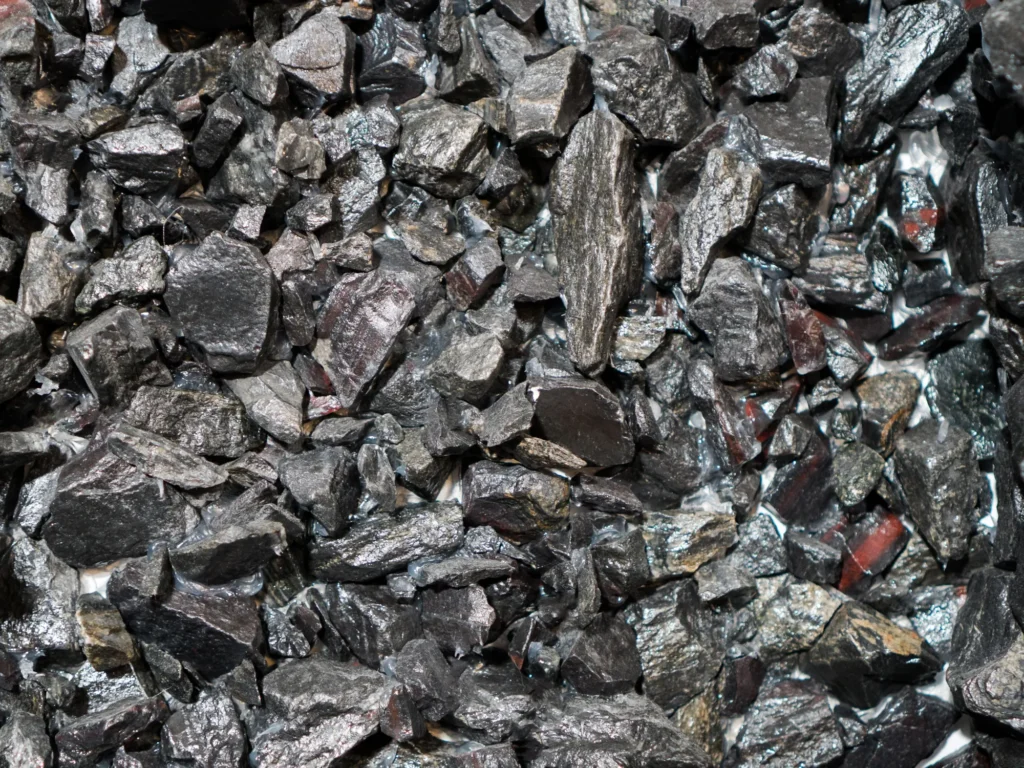
Iron ore consists of rocks and minerals from which metallic iron can be extracted. The four main types of iron ore deposits include:
- Massive Hematite (most commonly mined)
- Magnetite
- Titanomagnetite
- Pisolitic Ironstone
Iron ore varies in color, from dark grey to deep red and bright yellow. The red coloration in many rocks and sands, particularly in Australian deserts, is due to iron content.
Key Facts About Iron Ore
- Abundant Element – Iron makes up nearly 5% of the Earth’s crust.
- Steel Production – Around 1.6 tons of iron ore are needed to produce one ton of steel.
- Global Demand – The world uses 20 times more iron (in the form of steel) than all other metals combined.
- Massive Machinery – Our iron ore trains stretch over 2.5 km, with 264 ore cars.
- Large-Scale Shipping – The ships used to transport iron ore can carry an amount equivalent to 47 Olympic-sized swimming pools.
- Symbol – The chemical symbol for iron is ‘Fe’ (from the Latin Ferrum).
How is Iron Ore Used?
98% of all iron ore is converted into pig iron for steelmaking, which is then used in:
- Construction – Buildings, bridges, and essential infrastructure worldwide.
- Household Appliances – Found in ovens, washing machines, fridges, and dishwashers.
- Transportation – Planes, trains, ships, trucks, and cars rely on steel from iron ore.
- Energy Infrastructure – Used in wind turbines and electricity poles.
The Steel-Making Process
- Mixing with Coke – Iron ore is combined with super-heated metallurgical coal in a blast furnace.
- Heating – Air heated to 1,200°C is injected into the furnace, melting the iron ore into pig iron and slag.
- Purification – Impurities are removed, and alloying elements are added before the steel is cast, cooled, and rolled for use.
Where is Iron Ore Found?
Iron ore deposits exist worldwide, with major producers including Australia, Brazil, the U.S., and Canada.